Why Atiku Abubakar Remains Silent On Trump Genocide Claims In Nigeria And Threats Of Invasion

Nigerians as well as the international community were taken aback by the president of the United States of America, Donald J Trump who a few days ago, in ending of October, 2025, criticized the Nigerians leadership over its inability to rout insecurity ravaging the country for more than a decade.
President Trump in his scathing criticism of president Bola Ahmed Tinubu led government, insinuated complicity on the part of the Nigeria’s government.
Donald Trump thereafter redesignated Nigeria as a country of particular concern (CPC), citing vi0lent activities of islamic terr0rists which have claimed thousands of lives particularly among the Christian communities in the northern section of the Nigeria’s federation.
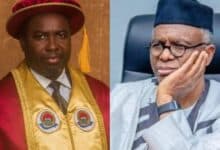
President Donald Trump enjoined the Nigeria’s leadership to intensify its fight against terr0rists, bandits and jih@dists who are understandably behind the incessant vi0lent attacks on communities, destroying homes and churches in Nigeria.
President Trump labelled the activities of these groups as “Christian Gen0cide”. He threatened Nigeria leadership with sanctions and possible military intervention if the Nigeria’s government do not take immediate actions to protect the Christian communities in Nigeria by going against the Islamist terr0rists in full force. President Trump disclose his administration intention to go after terr0r sponsors in Nigeria including those currently serving as governors, senators, members of the House of Assembly, and members of the Nigeria’s judiciary.
Thereafter, the response of the Nigeria’s authority to president Trump’s claims including reclassifying Nigeria as a country of particular concern and allegation of Christian Gen0cide was an immediate rebuttal. The Nigerian authority claims that there is no targeted k!lling of Christians in Nigeria as president Trump claimed. They explained that the vi0lent attacks in Nigeria are carried out by multinational and powerful terr0r groups such as Boko Haram and ISWAP whose activities affect people of various faith and religious belonging in Nigeria unlike what president Trump says.
The Nigeria’s government called for collaboration with the US military in military equipment, intelligence and funds and described Trump’s proposed direct military intervention in Nigeria as a threat on the Nigeria’s sovereignty.
Consequently, the situation has resulted in tense debate on and off Nigeria’s social media community and have drawn responses from the Nigeria’s social-political elite, but the silence of Nigeria’s former vice president, Atiku Abubakar has made many wonder why the former vice president whose 2027 political ambition remains a major threat to president Bola Ahmed Tinubu has neither spoken in support of president Trump nor for the Nigeria’s leadership.
As of November 8th, 2025, a few weeks since the uproar began, Atiku Abubakar has neither directly or through his media aides reacted to president Trump’s designation of Nigeria as country of particular concern, describing Nigeria as a disgraced country, and his threat of military intervention in Nigeria to protect Nigerian christians– not even a social media post, interview or a public statement.
Hence, Atiku Abubakar’s silence on this paramount national development which could have big impact on the outcome of the 2027 presidential election, has triggered serious concern among Nigerians and some political analysts.
Is Atiku Abubakar being strategic or lacking the willpower to take a stance on such an important national issue with great implication on the Nigeria’s history and potentially, Nigeria’s sovereignty?
Political analysts believe that Atiku Abubakar is being calculative and has made a strategic choice to remain silent on the issue. He believes that the issue is still emerging.
Also, Atiku Abubakar is not oblivious of Nigeria’s religious and ethnical intricacies; hence, his taking a stance for or against president Trump’s allegation of Christian Gen0cide in Nigeria would have dire political implication on his 2027 presidential ambition.
Atiku Abubakar would not want to align publicly with president Trump who has labeled Nigeria’s insecurity challenges as “gen0cide against christians” by islamists. Doing so would be endangering his political goodwill among the core northern muslims who have interpreted Trump’s statement as a direct threat against them. Recall that Atiku Abubakar was pressured to delete his tweet condemning the k!lling of Sokoto State College of Education female student, Deborah Samuel who was m0bbed by Muslim students over her alleged blasphemous statement about prophet Muhammad. Atiku Abubakar would have preferred if president Trump’s statement was specifically about insecurity in Nigeria and not targeted att@ck on christians in Nigeria.
Similarly, Atiku Abubakar is wary of losing the political support from the northern Christians should he attempt to rebut Trump’s Christian Gen0cide claims.
Moreover, rebutting Trump’s statement would amount to a significant political and business implication against him especially amid his alleged past fraudulent dealings in the United States.
Therefore, with his political and social pedigree, Atiku Abubakar believes in maintaining neutrality on the issue politically beneficial and diplomatically safer especially as Trump has threatened to sanction past and present Nigeria’s leaders who have directly or indirectly abetted att@cks on Nigerian christian communities.
On the other hand, Atiku Abubakar’s silence on this important issue carries its own risks. His critics argue that Atiku Abubakar by his position as a former vice president and one who looks forward to becoming the country’s president in 2027, is saddled with the responsibility of defending Nigeria by speaking up on issues as these especially when Nigeria’s sovereignty is threatened.
However, the complexity of the Nigeria’s social-cultural structure in which religion and ethnicity are in flux requires that one in the position of Atiku Abubakar threads cautiously especially in view of his political ambition. Understandably why Atiku Abubakar’s silence on this issue has become a predominant theme in recent national discussion.
Meanwhile, the president Tinubu’s administration has continued to maintain its earlier stance on insurgency being behind Nigeria’s insecurity challenges rather than an islamists agenda against Nigerian christians as president Trump stated.
Meanwhile, Peter Obi, a forefront presidential candidate for the 2027 general elections had in his response to president Trump’s statement, enjoined the two nations with long-standing commendable diplomatic relationship, to liaise necessary for the duo to adopt a more conventional strategy to routing insecurity threatening Nigeria’s corporate existence.
Peter Obi enjoined the ruling All Progressive Congress (APC) to focus on protecting lives and property of Nigerian which is the primary responsibility of the government rather than being obsessed about retaining political power in 2027 and beyond. Peter Obi blamed the APC government for its lack of genuine empathy for suffering Nigerians, noting that they often resort to politicking and pushing blames rather than tackling Nigeria’s numerous challenges.